Helen Radley
The RadleysHelen Radley is a wife and mother whose attempts to preserve an ordinary family life are repeatedly tested by vampirism, inherited hunger, and the return of Will. Her story turns on a painful distinction: a powerful bodily pull can feel real without being the truth she chooses to live by. Even when secrecy and blood threaten to overwhelm her, her love for Peter and her wish to return to her family remain decisive.
Identity and Family Life
Helen is married to Peter and is the mother of Clara and Rowan. At one early moment, she gets back into bed tense with secrets while Peter gives a yearning sigh and nuzzles into her. Their physical closeness does not dissolve what she is concealing; instead, the scene places domestic tenderness beside the strain of keeping the truth from the person beside her. The contrast recurs throughout her story: the Radleys try to maintain the habits of a household even while its members face a hidden condition that changes how they understand themselves.
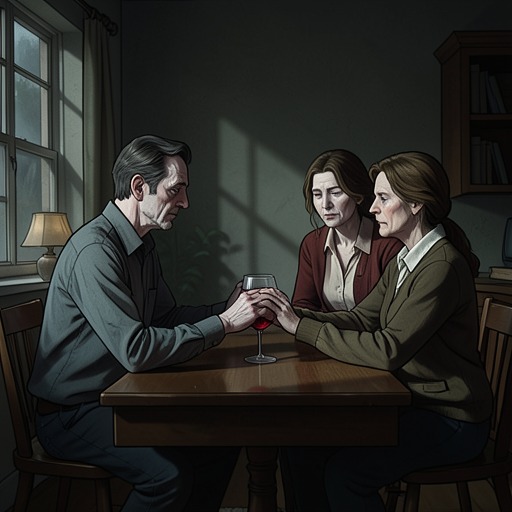
That effort to keep family life recognizable is especially clear at Sunday dinner. At four in the afternoon, the Radleys sit down to eat, and Peter studies the cooked lamb on his plate. Helen is determined that the meal should proceed as normal. Peter understands routine as a kind of therapy for her, making the dinner more than a domestic detail: it is one of the structures she uses to steady the family when ordinary appearances have become difficult to sustain. Her wish to avoid conflict with Peter likewise shows that preserving the marriage matters to her, even when the truth between them is hard to face.
Telling the Children
Helen helps explain the Radleys’ condition to Clara after a troubling incident involving a boy. She tells her daughter that she was provoked and that the episode brought out something in her. Helen describes the family condition as hereditary and links it to a hunger that must be carefully managed. When she begins to frame the explanation as a strange biological condition, Peter interrupts and tells Clara plainly that they are vampires. The exchange shows Helen trying to make an alarming truth understandable through the language of illness and inheritance, while Peter decides that their daughter needs the direct name for what they are.
Helen’s account treats Clara’s behavior not simply as wrongdoing but as a sign that her daughter needs help understanding an inherited hunger. The disclosure changes the terms of family life: the children are no longer being protected by silence, and the parents must explain both the condition and its risks. Later, Helen firmly tells Clara that she has had enough, a brief boundary-setting moment that sits alongside her earlier soothing reassurance. Her parenting thus combines explanation, comfort, and discipline rather than reducing her role to either concealment or control.
Will and the Pressure of the Past
Will’s return places Helen’s marriage and family under direct pressure. In one confrontation, she reminds him that she was engaged to Peter and loved him, then challenges Will over why he came after her and disrupted that life. Her questions connect his actions to rivalry, insecurity, or a desire to make others miserable, but the scene does not settle on one explanation. What it makes unmistakable is Helen’s anger at having her chosen future invaded and recast by Will’s presence.
Will’s attention to her is persistent. He regards her as desirable even though she has chosen a faster route toward mortality, and he claims he would still want her if she were old and wrinkled. The contrast between his gaze and Helen’s own priorities matters: his desire does not erase her attachment to Peter or make her consent to the life he proposes. Nearly two decades after a conversation with Will, Helen brings a policewoman into her living room. By then, the old relationship is entangled with present danger and police involvement, not merely private memory.
The pressure becomes immediate in the kitchen. Helen slices a whole-wheat loaf to make sandwiches for Peter’s lunch, keeping herself occupied while Alison Glenny’s ultimatum repeats in her mind and the task of confronting Will weighs on her. She does not notice Will watching her. He demands that she tell Peter and Rowan the truth about the situation, then says he will disappear, with or without her. He frames the decision as a choice between her head and her heart. Alison, meanwhile, has seen in Helen a steadfast hopelessness, as though Helen lacks control over her own actions and desires; her concern is not only that an abstainer faces a practicing vampire, but that Helen may be unable to act freely within that confrontation.
Resistance, Attachment, and Choice
Will’s blood intensifies the conflict. Helen is powerfully drawn to it, and the pull is described as deeply satisfying. Yet that bodily response does not resolve her choice. As Will bites her, she reaches for the bread knife and holds it horizontally behind his neck. The ordinary kitchen object becomes a possible weapon at the point when attraction and resistance meet. The scene does not make her struggle a simple triumph of will: it shows how a renewed attachment can coexist with an attempt to stop Will and protect herself.
When Will later urges her to return to Paris and relive their earlier magic, Helen begs to be allowed to go back to her family. Her clearest recognition comes inwardly: she loves Peter and has always loved him. The memory attached to that recognition is specific and ordinary—a gray day on Clapham High Street, walking hand in hand with Peter while he helps her shop for art supplies. Against Will’s appeal to revived romance, this recollection restores the texture of the life she chose with Peter. The past with Will may exert force, but the remembered future with Peter carries the meaning she claims as real.
Secrecy, Rescue, and Reconciliation
Helen’s relationship to family truth remains unfinished even after Will’s threat has passed. A shoebox lies open, with a letter on the floor and a photograph of Rowan beside it, bringing concealed family history into view through physical evidence. Later, Helen tells Peter that she needs to explain things about the past that still affect them, including Will, herself, and the whole family. She meets his smile with anxiety but does not retreat from the conversation. When Peter asks whether she loves him, she answers yes. The exchange makes reconciliation a beginning grounded in candor rather than a return to unexamined normality.
Helen also understands the consequences of blood exchange for Eve. She urgently explains to Jared that giving Eve blood will make her a vampire and that Eve is likely to develop very strong feelings toward the person whose blood is used. When she opens her eyes and sees Rowan bleeding into Eve’s throat, Helen recognizes that he is saving her. The moment places her knowledge of conversion beside an act of familial care: Rowan’s choice intervenes in Eve’s danger while creating the possibility of a consequential bond.
Helen’s narrative role rests on the tension between secrecy and disclosure, bodily compulsion and chosen attachment, and routine and rupture. She can soothe Clara, insist that the family face what it is, and still struggle to act under Will’s influence. Her eventual declaration of love to Peter does not erase that history; it establishes what she wants to make real after it. In this way, the ordinary images that recur around her—a shared bed, Sunday dinner, a loaf prepared for lunch, a remembered walk for art supplies—become measures of the family life she is trying to protect and recover.